Export guide
Exporting from Thailand to the world: the complete guide for general cargo
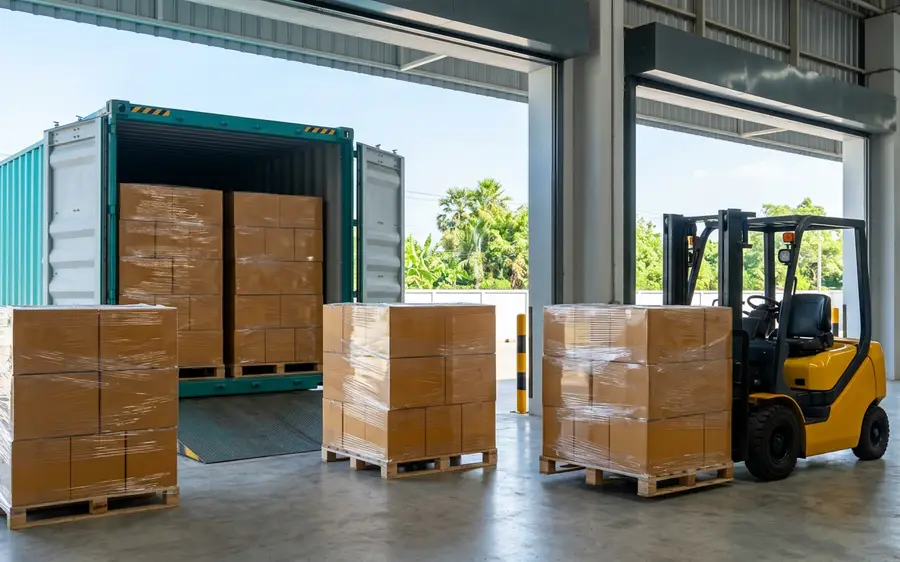
Most export shipments are not difficult. What makes them expensive is doing things in the wrong order: a price agreed before anyone checked the tariff code, or a certificate of origin applied for after the buyer needed it.
This guide follows the work in the order it happens, with extra attention on free trade agreements and the certificate of origin, where the rules moved furthest in 2026. It covers general cargo only. If your product falls outside that, the first section explains when to talk to us instead.
What counts as general cargo
General cargo here means packed goods that are not dangerous, need no temperature control, fit normal cartons, pallets or containers, and need no export permit or health certificate. Think packaged consumer goods, garments, plastic products, hardware, household items and non-controlled spare parts. This guide does not cover:
- Dangerous goods, including many chemicals, aerosols, paints and lithium batteries
- Food, drinks, plants, agricultural produce and anything needing a health or phytosanitary certificate
- Live animals, wildlife and CITES-listed species
- Goods under export control or licence, such as rice, sugar and gold, and dual-use items
- Medicines, medical devices, cosmetics and supplements
- Temperature-controlled, oversized, heavy-lift or project cargo
- Used goods, scrap and waste
Start with the tariff code and controls
Everything depends on the Harmonized System (HS) code. It decides whether the goods are controlled, what duty your buyer pays, which free trade agreements apply, and what description goes in advance cargo filings. The first six digits are shared internationally. Thailand extends the code to eight digits and other countries add their own, so your buyer's code can differ from yours.
Most goods leave Thailand freely, but the Ministry of Commerce can prohibit or license particular goods, and the lists change by notification. Check current notifications from the Department of Foreign Trade (DFT) rather than an older list found online.
Dual-use controls can catch goods that look ordinary. Thailand began licensing exports of Category 0, nuclear-related items, on 30 July 2026, and that narrow first phase is expected to widen. Check technical components, sensors, certain materials and equipment with the classification tool on the DFT's e-TCWMD system.
Then check the other end. Standards, labelling and import licences are normally the importer's job, but goods refused at destination become your problem. Ask the buyer in writing what is required, and check that neither the buyer nor the country is under sanctions.
Getting set up as an exporter
For general goods there is no separate exporter's licence. You need:
- A tax ID
- A way to file with Customs: your own Paperless registration with a digital certificate, or a licensed customs broker
- A DFT SMART-I account, if you will need certificates of origin
- A bank that handles foreign currency receipts and, if needed, letters of credit
- A forwarder who can quote, book and explain the cut-offs on your lane
Decide early whose name goes on the export declaration. That company is the exporter for Customs and the Revenue Department, which matters for zero-rated VAT and any certificate of origin. If you sell EXW and your buyer's agent files the declaration, that may not be you.
Price, delivery terms and payment
State an Incoterms 2020 rule and a named place on every quotation, and a validity date on any price that includes freight. For container cargo, FCA usually fits better than FOB, because you hand over the container long before it goes on board, and under FOB the risk stays with you until it does. Be careful with EXW for the reason above, and with DDP unless you know the destination's duties and taxes. Our Incoterms guide goes through all eleven rules.
An advance transfer protects the seller, open account protects the buyer, and a letter of credit or documents against payment sits between them. With a letter of credit the bank pays against documents, not goods, so read its conditions before the goods are packed.
For insurance, CIF only obliges the seller to buy minimum cover, Institute Cargo Clauses (C), while CIP requires the wider Clauses (A). Under FOB or FCA, check who is covered for loss before the goods pass to the buyer.
Packing and booking
Export packing has to survive stacking, humidity and repeated handling in a closed steel box. Use export-grade cartons, stack them stably, and mark each carton to match the packing list. Two requirements catch people out:
- Wood packaging. Solid-wood pallets, crates and dunnage generally have to meet ISPM 15, which means treated and stamped with the IPPC mark. An unmarked pallet can get a whole shipment held or sent back. Plywood and plastic pallets are outside the standard.
- Verified gross mass (VGM). Under the SOLAS convention, the shipper must declare a verified weight for every packed export container. A container with no VGM should not be loaded, so ask your carrier for its deadline.
| Mode | Suits | Watch out for |
|---|---|---|
| Sea FCL | Volumes that fill or nearly fill a container, usually through Laem Chabang | Container, documentation and VGM cut-offs, and free time at origin |
| Sea LCL | Smaller shipments sharing a container | Earlier cut-offs at the consolidation warehouse, more handling, longer door-to-door time |
| Air | Urgent, high-value or light goods, usually through Suvarnabhumi | Chargeable weight, and security screening of the consignment |
| Land | Neighbouring countries, by truck through a border crossing | Crossing hours, permitted cargo and whether that crossing is currently open |
Book as soon as the ready date is reliable, and work back from the cut-offs rather than forwards from production. A missed cut-off usually means waiting for the next sailing, with storage and rebooking costs.
Some destinations want cargo data before loading. For deep-sea containers, the US Importer Security Filing and the EU's ICS2 entry summary declaration both fall due 24 hours before loading. Someone else files them, but on your data, so give an accurate description and HS code early. Vague wording such as 'general goods' is likely to be rejected.
The document set
| Document | Prepared by | What it does |
|---|---|---|
| Commercial invoice | Exporter | States the sale and value. Used by Customs, the buyer, the bank and the origin authority |
| Packing list | Exporter | Shows packages, contents, weights and dimensions |
| Export declaration | Exporter or customs broker | The legal record of the export, and the evidence behind zero-rated VAT |
| Bill of lading or air waybill | Carrier or forwarder | Evidence of carriage. An original bill of lading can also control release of the goods |
| Certificate of origin | DFT, an authorised body or an approved exporter | Proves origin, and supports a duty preference where one applies |
| Insurance certificate | Insurer | Needed where the seller arranges cover, as under CIF or CIP |
EORI numbers for Europe
An EORI (Economic Operators Registration and Identification) number identifies a business to customs in the European Union. It belongs to whoever handles the import, so on an ordinary sale under FOB, CIF or DAP your buyer clears the goods under their own EORI and you normally do not need one. Ask for their number before you ship, because carriers may want it on the commercial invoice. Two cases differ:
- DDP sales. You take on the import and will normally need your own EORI, registered in the member state of your first customs operation. You generally also need an indirect customs representative established in the EU, who shares liability for the duty, and you have import VAT to deal with. The EU is reforming its customs code, so take advice before you quote.
- The UK. Great Britain uses numbers starting GB and Northern Ireland uses XI, so a buyer in Great Britain needs a GB number rather than an EU one.
Clearing Thai export customs
Thai exports clear through the Customs Department's e-Export system, filed by the exporter, a customs broker or a service counter. The department's manual sets out five stages:
-
Export declaration
The exporter or broker files it on an FOB value basis. The system returns a declaration number, and any duty is paid at this stage.
-
Stuffing and the goods transition document
The goods are packed, and the goods transition document (ใบกำกับการขนย้ายสินค้า) links the container to the declaration.
-
Moving the goods to the port, airport or border
The cargo passes through the load station at the place of export, ahead of the carrier's cut-off.
-
Matching against the declaration
The system and the officer match the cargo to the documents. Green-line cargo goes forward without inspection. Red-line cargo is opened and checked.
-
Loading
The carrier loads the goods and the record is closed. Confirm the final status, and if the cargo moves to a later vessel, make sure the change is recorded.
Most ordinary goods carry no export duty, but check the tariff line once rather than assuming. A false description or value on an export declaration is a customs offence even when no duty is at stake.
The certificate of origin: two different documents
A certificate of origin (C/O, or Form CO) states the country where goods originate, which is not always the country they shipped from. There are two kinds, and exporters often ask for one when they need the other.
Preferential certificates, for a lower duty rate
These exist under a specific trade agreement: Form D for ASEAN, Form E for China, and so on. Your buyer presents one to their customs to pay a reduced duty rate or none. The saving goes to the buyer, but it often decides whether you keep the order. In Thailand, the DFT is the issuing authority.
The general certificate, for proof of origin alone
The general certificate, known as Form C/O, gives no duty reduction. It simply evidences origin, usually because a buyer, a bank or the destination's customs asks for it. Besides the DFT, the Thai Chamber of Commerce and the Federation of Thai Industries also offer certification.
Thailand's free trade agreements
Thailand has 14 free trade agreements in force, each with its own proof of origin:
| Market | Agreement | Proof of origin |
|---|---|---|
| ASEAN | ATIGA | Form D or e-Form D, or an Origin Declaration by a certified exporter |
| China | ASEAN-China (ACFTA) | Form E |
| South Korea | ASEAN-Korea (AKFTA) | Form AK |
| Japan | ASEAN-Japan (AJCEP) | Form AJ |
| Japan | Thailand-Japan (JTEPA) | Form JTEPA |
| Australia, New Zealand | ASEAN-Australia-New Zealand (AANZFTA) | Form AANZ |
| Australia | Thailand-Australia (TAFTA) | Certificate of origin under TAFTA |
| New Zealand | Thailand-New Zealand (TNZCEP) | Invoice Declaration |
| India | ASEAN-India (AIFTA) | Form AI |
| India | Thailand-India (TIFTA) | Certificate of origin under TIFTA, for the 83 items it covers |
| Hong Kong | ASEAN-Hong Kong (AHKFTA) | Form AHK |
| Peru | Thailand-Peru | Form TP |
| Chile | Thailand-Chile | Form TC |
| ASEAN, China, Japan, South Korea, Australia, New Zealand | RCEP | Form RCEP, or a Declaration of Origin by an approved exporter |
Several markets have more than one route: China under Form E or RCEP, and Japan under JTEPA, AJ or RCEP. Choose the one with the lowest duty for that tariff line whose rule of origin your goods meet, and agree the form with your buyer.
What is coming
- Signed but not yet in force: Thailand-EFTA (Switzerland, Norway, Iceland, Liechtenstein), expected in early 2027; Thailand-Sri Lanka, with a target of 1 January 2027; and Thailand-Bhutan.
- In negotiation: Thailand-EU, a Thailand-South Korea CEPA, ASEAN-Canada, a Thailand-UAE CEPA, Thailand-Pakistan and Thailand-Turkey.
- Upgrades: the ACFTA 3.0 protocol, signed in October 2025, and a second ATIGA protocol, with formal effect planned for June 2027. Both may change rules and forms.
Do your goods qualify?
An FTA only covers goods that meet its rule of origin, set product by product by HS code. The tests you will meet most often are:
- WO
- Wholly obtained: the goods were entirely produced in the member country, with no imported materials.
- RVC
- Regional value content: a stated share of the FOB price, often 40%, comes from the member countries. The ACFTA test works this way.
- CTC / CTH
- Change in tariff classification: imported materials have been transformed enough for the tariff code to change, for example at four-digit heading level (CTH).
- Specific process
- A named manufacturing or processing operation has been carried out in the member country.
The same product can pass under one agreement and fail under another. Agreements such as ACFTA and RCEP allow cumulation, where materials from other members count towards your content. Product rules are also tied to an HS edition, which may not match the code you use today.
The journey matters too. Goods generally have to travel directly between members, or pass through a third country without further processing. Check the rule first if the shipment moves through a transit hub, is invoiced from a third country, or uses a back-to-back certificate.
How to apply for a certificate of origin
DFT applications run online through connected systems:
-
Register on DFT SMART-I
This one account also signs you in to DFT SMART C/O and ROVERs PLUS.
-
Have the goods' origin checked
Submit the product's costs, materials and production process through ROVERs PLUS, well before the first shipment, because a new product can take time.
-
Apply for the certificate
File the form in DFT SMART C/O with the invoice and transport details for that shipment.
-
Send it to the buyer
Forward the issued certificate so it reaches your buyer before they clear the goods.
Timing depends on the agreement. Form D is issued before or at shipment, or within three days of the declared shipment date. In exceptional cases it can be issued retroactively, up to one year from shipment. It is valid for 12 months from issue, and RCEP proofs of origin for one year. Other agreements differ, so apply on time.
Regular exporters can apply to certify their own goods through ASEAN-wide self-certification or RCEP's approved exporter route. Both need DFT approval first and put responsibility for accuracy on your company.
We prepare and file these applications for clients, and we can compare the available forms for your tariff line before you commit to a price.
Exports to the US and EU: the 2026 watch-list rules
Even with no FTA to claim, origin can matter in these markets. The DFT keeps watch lists of products at risk of origin fraud, and revised guidance took effect on 1 June 2026, covering 67 items for the United States and 9 for the European Union. If your tariff code is listed and you need a general Form C/O from the DFT for that market:
- Obtain the cost check result through ROVERs PLUS before you apply
- Apply through DFT SMART C/O with the invoice, the bill of lading or air waybill, and the cost check approval
- Plan renewals: a result lasts one year for the US and two years for the EU
Check the lists on the DFT website each time you add a product. The DFT hotline is 1385.
Since 24 July 2026, most Thai-origin goods entering the US have faced a 12.5% Section 301 tariff on top of the normal duty. Goods under Section 232 tariffs and other listed products are excluded, and a separate US investigation could add more. Your buyer will want to know the real origin of what you sell, especially if it contains imported components.
After the goods have gone: what you can claim back
- VAT. Exports are zero-rated under Section 80/1 of the Revenue Code, so a VAT-registered exporter charges 0% and can still recover input VAT. The export declaration in your name is the core evidence.
- Import duty on inputs. Section 29 of the Customs Act B.E. 2560 (2017) refunds import duty on materials used to make or pack exported goods. As a rule, the goods must be exported within one year of import and the claim made within six months of export.
- Other schemes. If you hold BOI privileges or operate in a bonded or free zone, tell your broker before the declaration is filed.
- Foreign currency. Under Bank of Thailand rules, receipts of USD 1 million or more must be brought into Thailand within 360 days of the export date, then sold to or deposited with an authorised bank.
- Records. Thai accounting and VAT rules require records to be kept for at least five years. Keep the declaration, invoice, transport documents, certificates and cost data together, as origin checks can come well after shipment.
Pre-shipment checklist
- Goods confirmed as general cargo, or reviewed by a specialist
- HS code confirmed and agreed with the buyer
- Export controls, dual-use lists and DFT watch lists checked
- Destination requirements confirmed in writing by the buyer
- Buyer's EORI number on file for EU and UK shipments
- Incoterms 2020 rule, named place and payment terms agreed
- Best FTA and form identified, and origin check still valid
- Name on the export declaration decided
- Packing, shipping marks and ISPM 15 wood packaging ready
- Booking made, cut-offs in the calendar and VGM submitted
- Invoice, packing list and transport document all match
- Declaration filed, certificate sent to the buyer and file stored
Summary
Get the tariff code right, confirm the goods can leave and can arrive, price on a clear Incoterms rule, and work back from the cut-offs. Treat origin as a commercial decision, not a last-minute form, because the best FTA for your product can be what wins or keeps the order.
If your goods are dangerous, regulated, temperature-controlled, oversized or simply unusual, or you would like someone to check your tariff code and FTA options before you quote, get in touch. Worldlink has been handling Thai freight and customs clearance since 1995.